

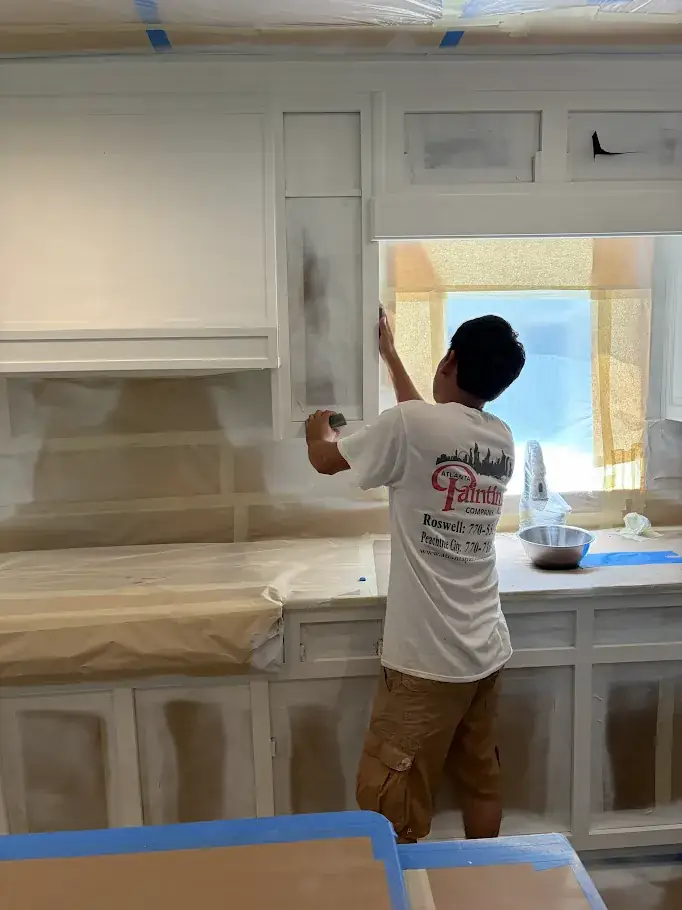
Why prep decides how long the coat lasts
The hours go into the wall before the coat you see. In metro Atlanta the thing working against the coat is moisture: humid summers, dew on north walls, pollen stuck to damp siding, and red clay splashed along the foundation. Inside, it is grease on kitchen walls, mildew in baths, and patches that flash when the afternoon sun hits them. Skip the repair and the new paint copies the old problem. A cheap bid usually saves its time in this part of the job.
We walk the house with you and write down cracks, stains, water marks, soft wood, nail pops and peeling. On homes built before 1978, we settle lead testing and a lead-safe plan before anyone disturbs a suspect coating. What we find goes into the written scope, so the repairs are agreed before the crew starts. That list is different on the outside of the house than it is in the rooms, which is why exterior painting and interior painting are scoped separately even when they are on the same visit.
Exterior prep in this climate
Outside, the sequence is wash, dry, repair, prime, then paint. The wash takes off pollen, mildew and clay. The wall then has to dry. Coating a shaded elevation while it is still cool and damp is how blistering starts, especially under the trees in Canton, Roswell and the rest of the north metro. Soft wood is cut out and replaced. Gaps at trim, windows and siding are caulked. Bare wood and tannin-prone cedar get a primer that matches the substrate. Paint will not fill a crack or seal an open joint, so those repairs happen first.
We schedule the outside around dew, heat and rain. The morning dew has to burn off before the first coat, and the crew stops early enough for the film to set before evening. The temperature and the dry time still come from the label on the can. If the forecast puts rain or a cold night on a coat that has not cured, that coat waits. More on how humidity shows up after a job is in is the Atlanta humidity ruining your paint.
Interior prep
Inside, the dirt is different and so is the repair. Kitchen walls get degreased. Bathroom walls get treated for mildew so the new coat can bond. Drywall cracks, nail pops and old picture holes are filled and sanded until the patch disappears into the wall. Stains from a past leak are primed so they do not bleed back through a light color. Glossy trim is scuffed so the next coat has something to hold.
Sanding does two jobs. It feathers a patch into the surrounding wall, and it knocks the sheen off a slick surface. On trim, a light sand between coats is what makes the finish feel smooth when you run a hand over it. Ceilings with old repairs usually want a flatter sheen so the waves and patches stay quiet. Halls and kids' rooms, which get wiped down, want a sheen that can take that wiping. The sheen choice is part of the scope, written down with the color.
Occupied houses need the furniture shifted, the floors covered and the switches taped before any paint is opened. Clean lines at the ceiling and the trim come from that masking and from cutting in by hand. We keep the HVAC running so the rooms stay in the range the label calls for. A closed-up house with the air off in July is a poor place to paint, and a house with the heat off in January can be just as poor if the rooms fall under the minimum on the can.
What you should see in the estimate
Prep is a line in every estimate we write. You should be able to read which rooms are washed, which walls are repaired, where primer goes, and what is being caulked outside. If a bid is silent on those items, the price is missing the work that keeps the finish in place.
The Canton office serves Canton and the surrounding neighborhoods, and the same prep list is what we walk in Roswell, Marietta and Johns Creek. Every job carries our 3-year warranty on labor and materials. The warranty assumes the prep in the scope was done. That is the practical reason it is written down before the first gallon is opened.